Liquidity mesh. NKEI. Corridor replication.

Institutional depth for retail execution, a closed-loop contribution economy, zero-trust custody, and a stage-gated 2026–2035 roadmap.

Institutional depth for retail fills

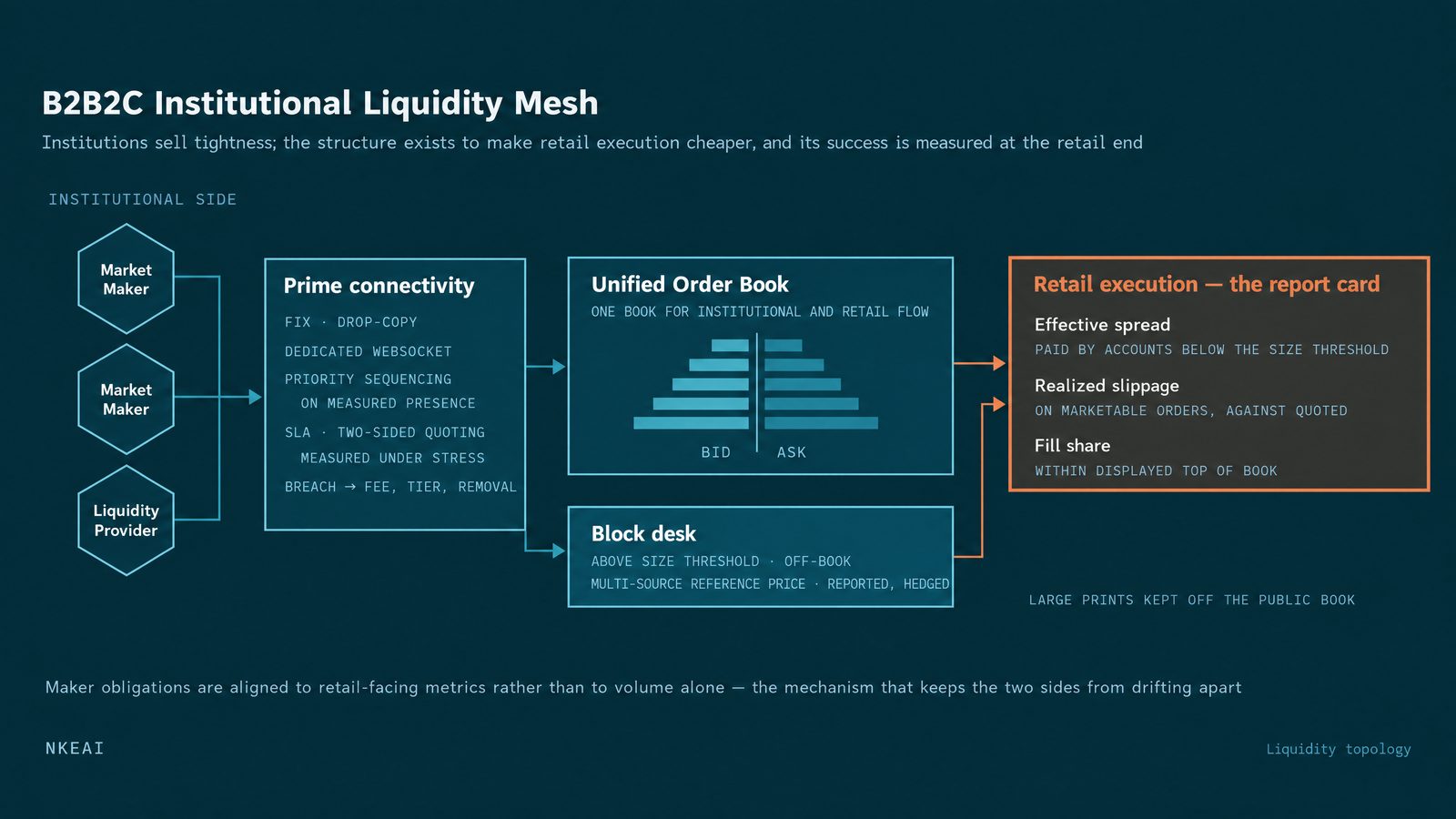
B2B2C prime connectivity, OTC, and liquidity obligations exist so retail participants can fill near quoted prices — not so the platform can advertise depth that evaporates under stress. Service classes publish availability targets rather than marketing slogans.

Institutional liquidity mesh

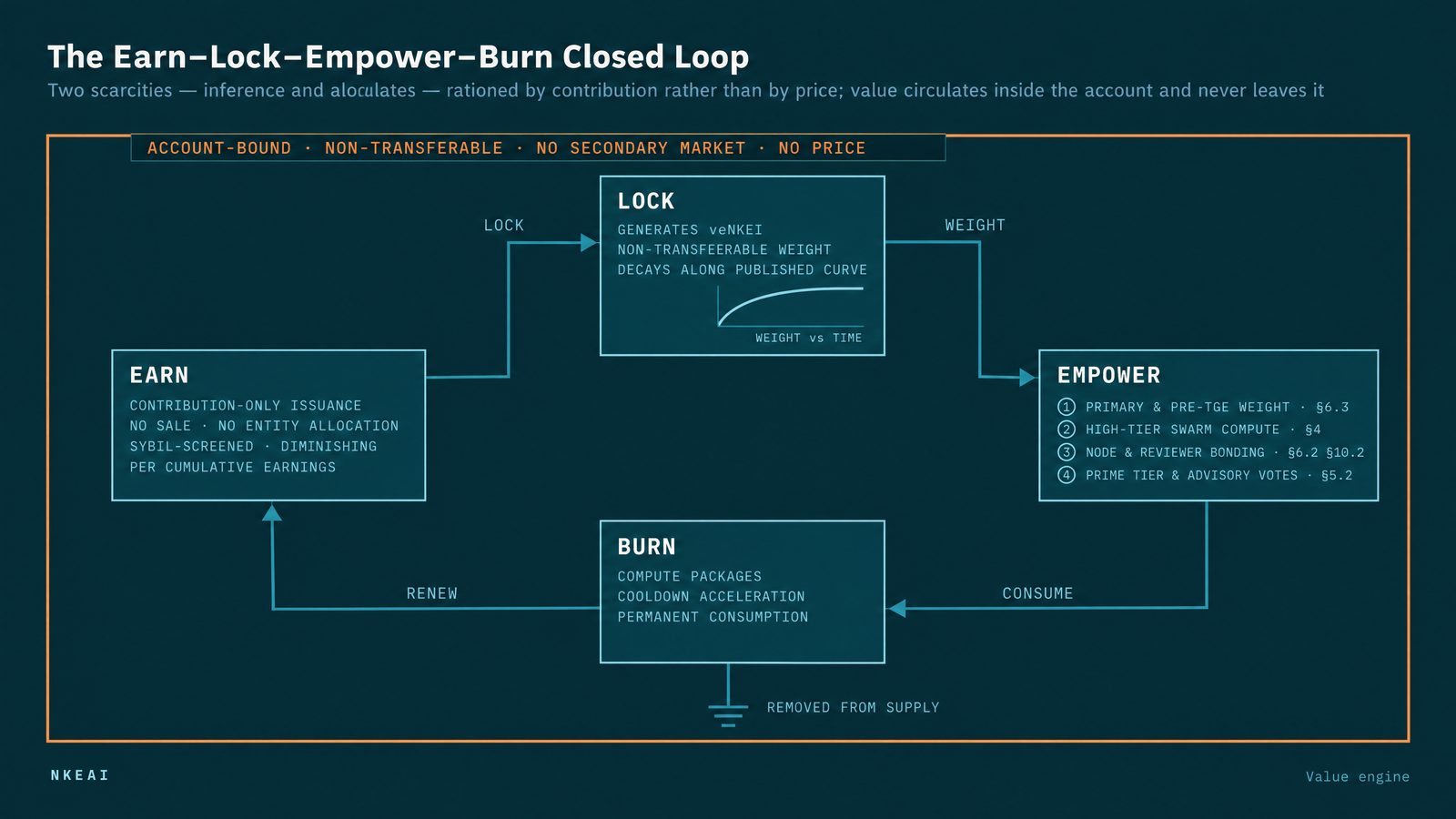
Earn · Lock · Empower · Burn

NKEI is an account-bound, non-tradable ecosystem access unit. It is not offered for sale, carries no redemption right, dividend, revenue share, or expectation of financial return, and is not listed or intended to be listed.

NKEI earn lock empower burn loop

No price is stated, no yield is offered, and no repurchase commitment exists. The instrument’s value proposition is access to things that are scarce and that money alone cannot buy — compute, review weight, and primary-window priority within hard caps.

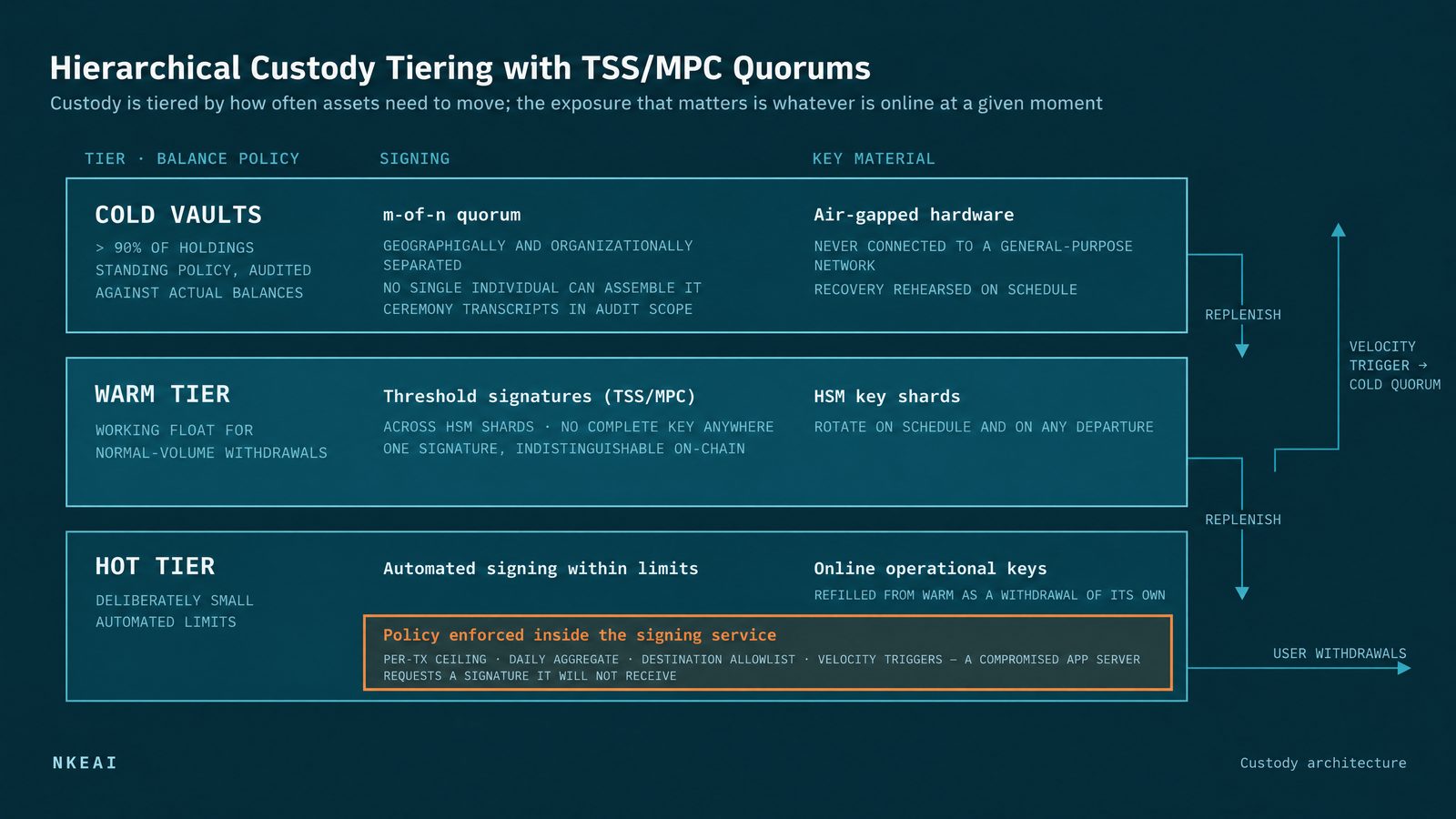
TSS/MPC, air-gapped vaults, PoR

Cold vaults target more than 90% of holdings at all times as a standing policy constraint. Warm-tier threshold signing produces a valid signature without any complete key in one location. PoR answers a narrow question: at this moment, does the operator hold at least as much as it owes — and can a customer confirm inclusion.

ZK-PoR is useful and not yet counted toward production claims. A proof of reserves says nothing about asset quality, liquidity, or liabilities not recorded on the tree.

Hierarchical MPC custody

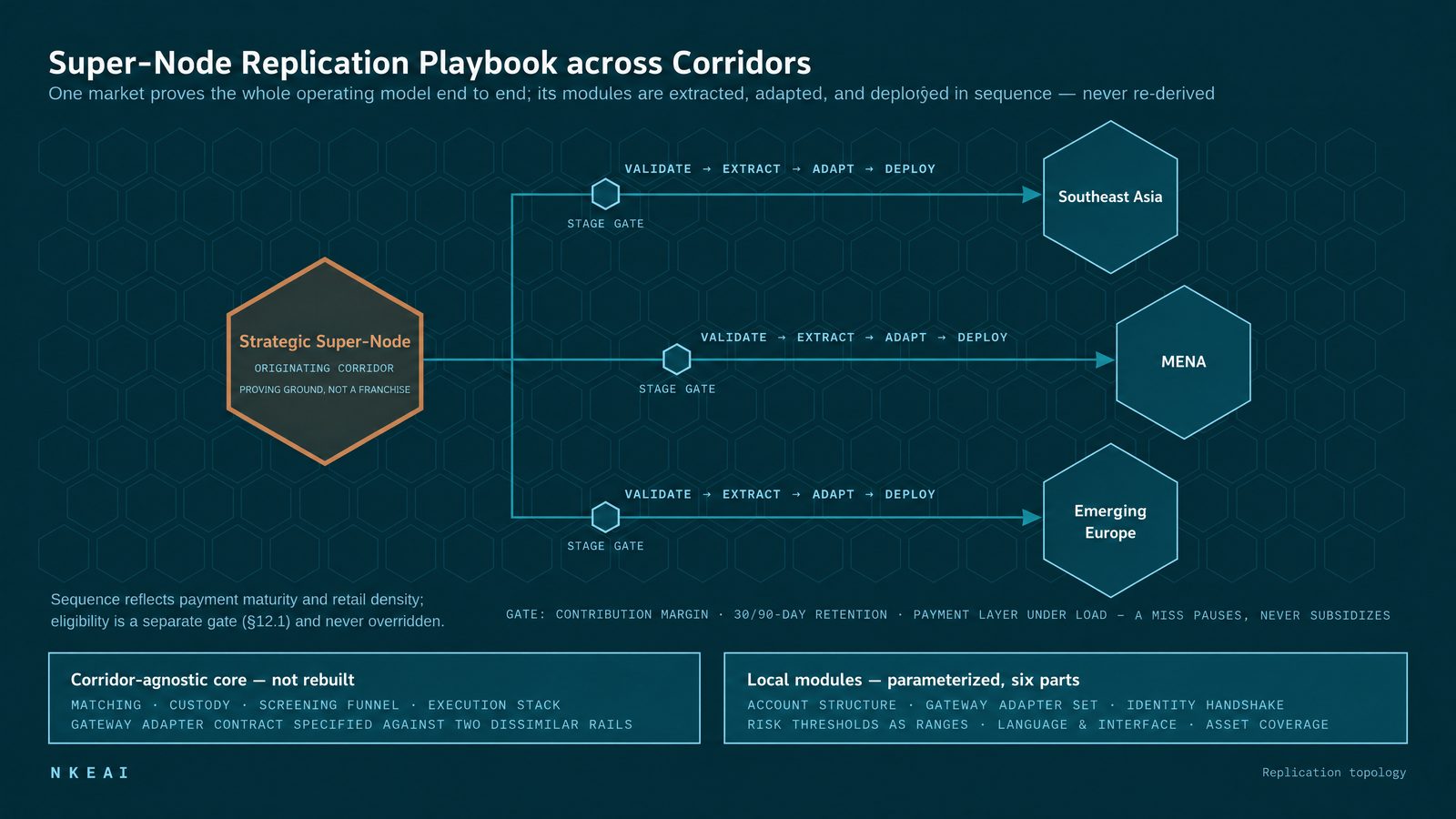
Super-node playbook. Messaging-native growth.

Modules proven in the originating corridor redeploy into Southeast Asia, MENA, and emerging Europe without re-deriving the core. Messaging-native distribution and social copy-intelligence extend reach where mobile-first habits already dominate settlement.

Global corridor replication playbook

Three strategic horizons

Stage-gate governance: horizons open when measurable conditions are met. Slipping a gate is not a failure of the plan; enabling a module early to meet a published date is.

Horizon I · 2026–2028

Super-Node Ignition & Intelligent Core

Unified account, matching core, five-layer stack, and primary-access matrix into production. Gate: independent load/stress metrics, custody attestation on schedule, positive unit economics in the originating corridor.
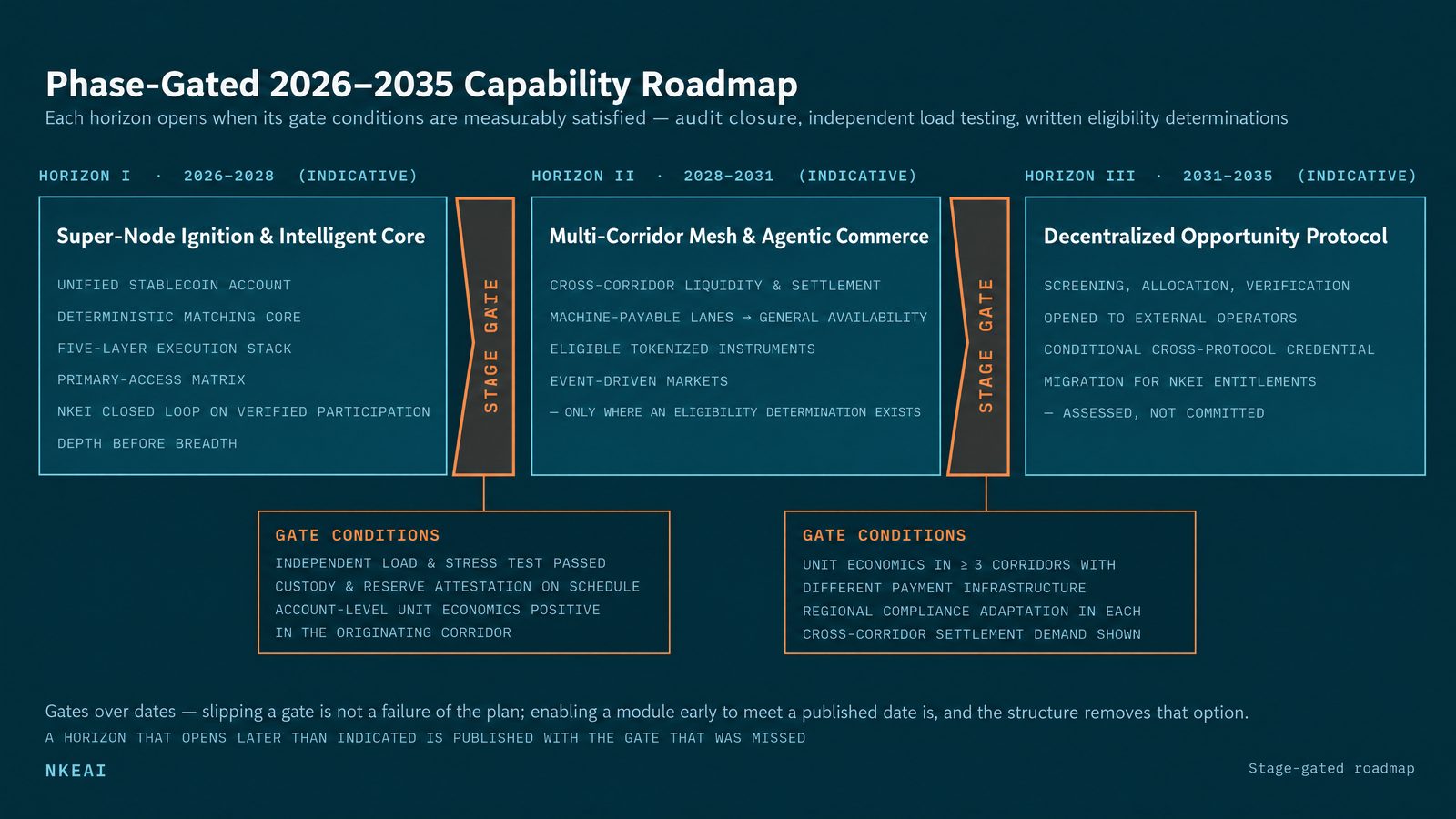
Horizon II · 2028–2031

Multi-Corridor Mesh & Agentic Commerce

Cross-corridor settlement, machine-payable APIs to general availability. Gate: unit economics in at least three corridors; completed regional compliance adaptations; demonstrated cross-corridor demand.

Horizon III · 2031–2035

Decentralized Opportunity Protocol

Modular opening of screening, allocation, and verification to external operators — conditional, not promised as a destination.

Phase-gated capability roadmap

Trust

Compliance-by-design & risk matrix