01
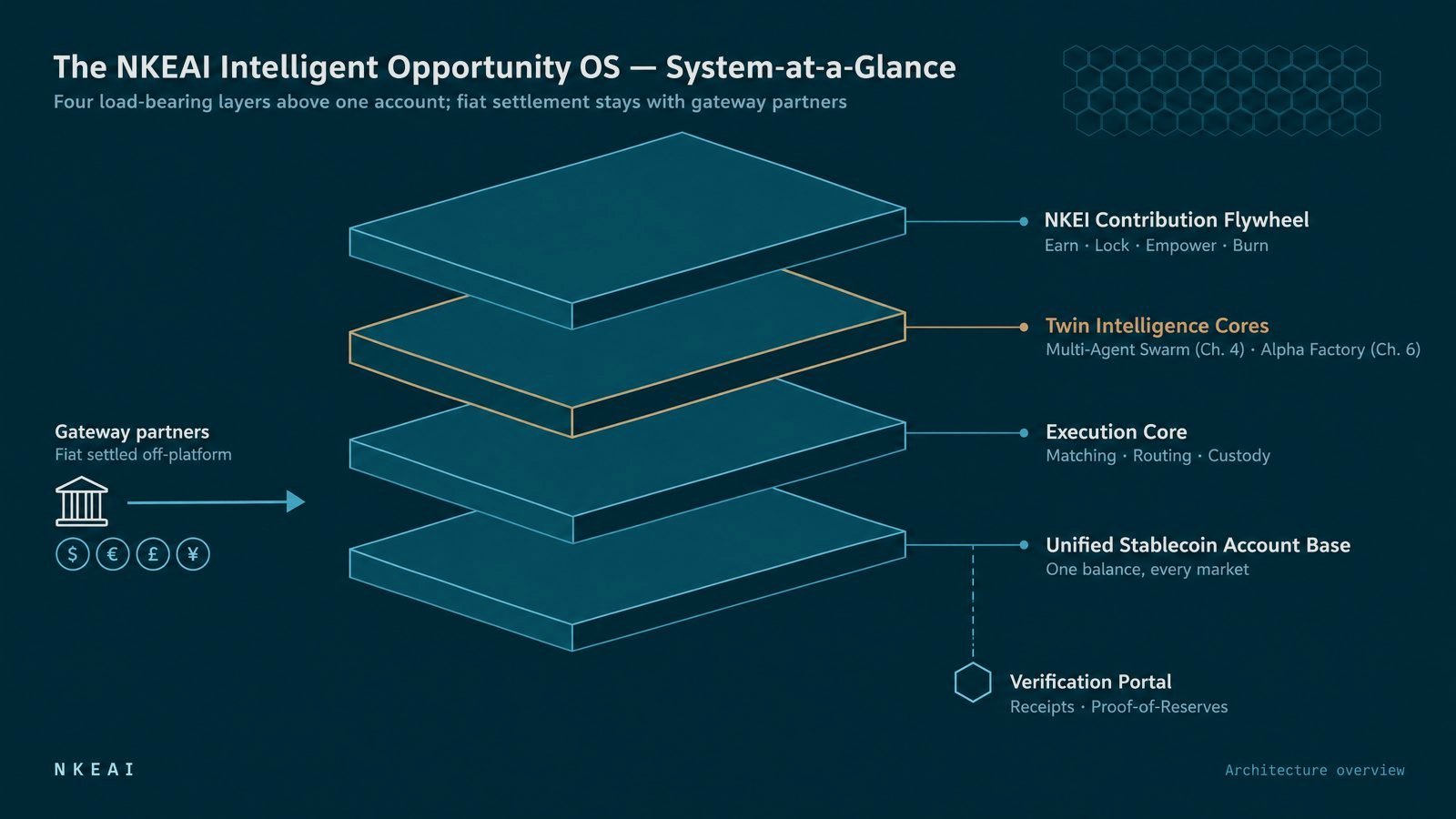
Unified stablecoin-native account
A single digital-dollar balance serves as collateral everywhere it is accepted — removing the idle-capital tax that sub-accounts impose on small portfolios.
NKEAI
Converging multi-agent AI execution, unified stablecoin accounts, and verifiable primary access across high-growth corridors.
Operating Thesis
NKEAI’s thesis is that the unsolved problems of sizing, fill quality, and legitimate early access share a single root cause: the retail account is structured as a terminal for placing orders rather than as an instrument for acquiring access. The architecture has three load-bearing parts — a unified stablecoin-native account, a multi-agent execution stack with an Alpha Factory for primary access, and a contribution economy denominated in NKEI.
“Access Parity — the design objective that a retail participant with a funded account, a verified identity, and genuine platform engagement should face the same class of information, the same class of execution tooling, and the same class of allocation opportunity as a professional desk.” Whitepaper · §1.1 Access Parity
01 — Three Parts
Three load-bearing parts of the architecture — each defined once in the chapters indicated.
A single digital-dollar balance serves as collateral everywhere it is accepted — removing the idle-capital tax that sub-accounts impose on small portfolios.
Specialized models reason in parallel over a shared evidence layer; an intent parser converts constrained requests into executable plans. Primary access is screened, not sold as spectacle.
Account-bound units that cannot be transferred or sold — weighting access, compute, and review privileges toward participants who actually use the platform. No public sale. No secondary market.
02 — Five Pillars
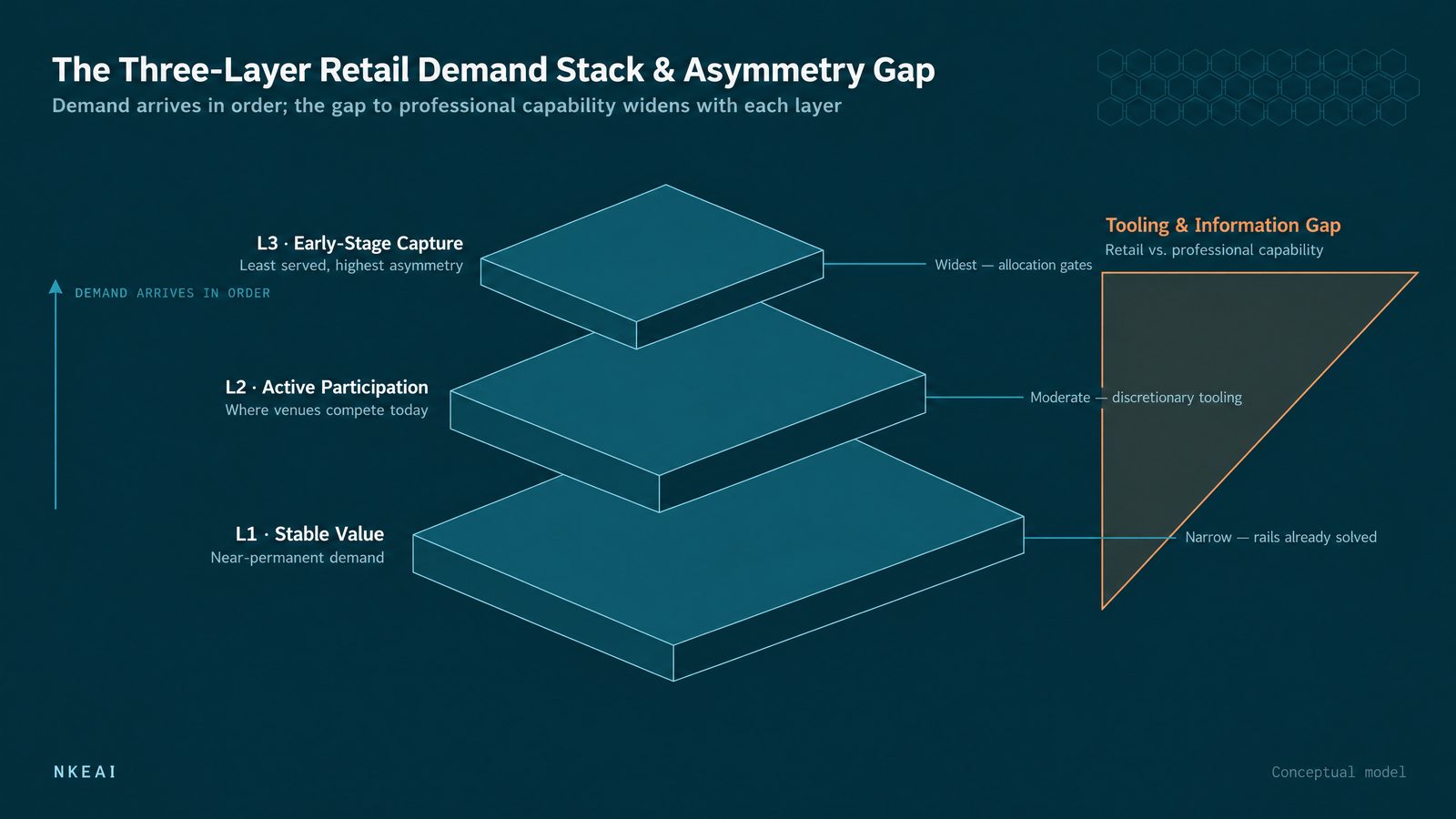
Organized around the three demand layers — with a fourth column for instruments whose risk profile keeps them out of general availability.
Major pairs and USD-margined perpetuals on the unified stablecoin base — liquidation prices shown before a position opens.
Agent-assisted strategy vaults and full-cycle primary access — pre-TGE, fair-curve, and tiered distribution under engagement gates.
Event-driven outcome markets are geo-gated; tokenized RWA remains contingent on custody and jurisdictional treatment.
03 — Horizons
Each horizon opens when gate conditions are satisfied — audit completion, load testing, corridor economics — not when a calendar cell arrives.
Unified account, matching core, five-layer execution stack, and primary-access matrix into production in the originating corridor.
Cross-corridor liquidity, machine-payable API lanes to general availability, and unit economics in at least three corridors.
Modular opening of screening, allocation, and verification to external operators — conditional on cross-jurisdiction readiness.
Next
U.S.-incorporated baseline. Product availability varies by jurisdiction and verification tier. Architecture described; modules gated by eligibility class.